


The Hidden Cost of File Sprawl in Biopharma R&D
Biopharma R&D teams generate an enormous volume of files—raw instrument data, protocols, analytical reports, SOPs, batch records, and regulatory documentation. As organizations grow, these files often end up scattered across shared drives, personal folders, cloud storage tools, and email attachments. This fragmentation, commonly referred to as file sprawl, introduces hidden operational costs that compound over time.
File sprawl rarely stems from poor process. More often, it’s a side effect of rapid growth, cross-functional collaboration, and evolving infrastructure. Teams adopt new tools, onboard new scientists, or work with external partners, and files are stored wherever it’s fastest or most convenient. Over time, this creates multiple versions of the same document, unclear ownership, and limited visibility into where critical data lives.
The immediate impact is inefficiency. Scientists and operations teams spend valuable time searching for files, validating whether they’re using the latest version, or recreating work that already exists but can’t be found. As programs scale, these small inefficiencies add up—slowing timelines, increasing costs, and distracting teams from high-value scientific work.
Left unaddressed, file sprawl becomes more than an inconvenience. It increases the risk of rework, data loss, and compliance challenges, especially as biopharma organizations move toward later-stage development and regulated environments.
Why Rework and Data Loss Are So Common in Growing R&D Teams
As biopharma R&D organizations grow, rework and data loss become increasingly common—not due to a lack of rigor, but because existing file management practices fail to scale. Systems that once worked for small research teams quickly show limitations as data volume, team size, and collaboration complexity increase.
One of the biggest contributors is the absence of a clearly defined source of truth. When files are spread across multiple locations, teams often struggle to determine which version is current, complete, or approved. This uncertainty leads to repeated work and avoidable delays.
Common drivers of rework in growing R&D teams include:
Multiple versions of the same file stored across shared drives, cloud folders, and personal desktops
Limited visibility into where prior analyses, protocols, or results are stored
Manual handoffs between teams that require recreating or reformatting files
Low confidence in data integrity, prompting teams to rerun experiments or analyses “just to be safe”
Data loss, while less visible, poses an equally serious risk. Files stored outside a controlled system are vulnerable to accidental deletion, overwrites, or loss during employee turnover. In regulated environments, missing raw data or supporting documentation can compromise audits, investigations, and regulatory submissions.
Data loss often occurs due to:
Files saved locally or in personal folders without backup or retention policies
Untracked edits that overwrite original data
Ad hoc file sharing with external partners
Lack of standardized ownership and access controls
As R&D operations expand, these issues shift from isolated inconveniences to systemic risks. Reducing rework and preventing data loss requires infrastructure built to support growth, traceability, and long-term scientific accountability.
What a Centralized File Repository Really Means for Modern Labs

In many organizations, “centralized file storage” is often misunderstood as simply moving files into a single shared drive or cloud folder. For modern biopharma labs, a centralized file repository goes far beyond basic storage. It serves as a structured system of record designed to support scientific workflows, collaboration, and long-term data integrity.
A true centralized file repository provides a consistent framework for how files are stored, accessed, and managed across teams. Instead of relying on individual naming conventions or personal folder structures, files are organized in a standardized way that makes them easy to find and reuse. This reduces ambiguity around file ownership and eliminates guesswork about which version should be used.
Key characteristics of a centralized file repository for modern labs include:
Centralized access to all relevant scientific and operational files in one controlled environment
Clear versioning to ensure teams can distinguish between drafts, final files, and historical records
Role-based permissions that protect sensitive data while enabling collaboration
Searchable structure that allows users to quickly locate files without relying on institutional memory
Just as important, a centralized repository connects files to the broader R&D context. Rather than existing as isolated documents, files can be associated with specific projects, experiments, samples, or processes. This contextual linkage makes it easier to understand how data was generated, how it evolved, and how it should be interpreted.
For growing biopharma organizations, a centralized file repository is not about control for its own sake. It is about creating clarity, consistency, and confidence in how scientific data is managed—so teams can focus less on file logistics and more on advancing research.
Reducing Rework by Creating a Single Source of Truth
Rework in biopharma R&D often stems from uncertainty. When teams are unsure which file is current, complete, or approved, they compensate by recreating work, repeating analyses, or rerunning experiments. Establishing a single source of truth is one of the most effective ways to break this cycle.
A centralized file repository provides a designated system where authoritative files live. Instead of relying on copies stored across personal folders, shared drives, or email threads, teams know exactly where to go for the most up-to-date information. This clarity reduces hesitation and eliminates the need to “double-check” work that has already been done.
Creating a single source of truth helps reduce rework by:
Eliminating duplicate files and conflicting versions across teams
Ensuring consistent access to the latest protocols, data sets, and reports
Preserving historical context through controlled version history
Reducing manual validation when files are reused downstream
When files are centrally managed, updates are visible to everyone who depends on them. Changes to protocols, analytical methods, or results no longer require manual communication or re-distribution. Teams can confidently build on existing work, knowing they are working from validated information.
Over time, this consistency compounds. Fewer repeated tasks mean faster iteration, better resource utilization, and more predictable development timelines. By anchoring work to a single source of truth, biopharma teams can shift from reactive rework to proactive progress.
Improving Cross-Team Collaboration Without File Duplication
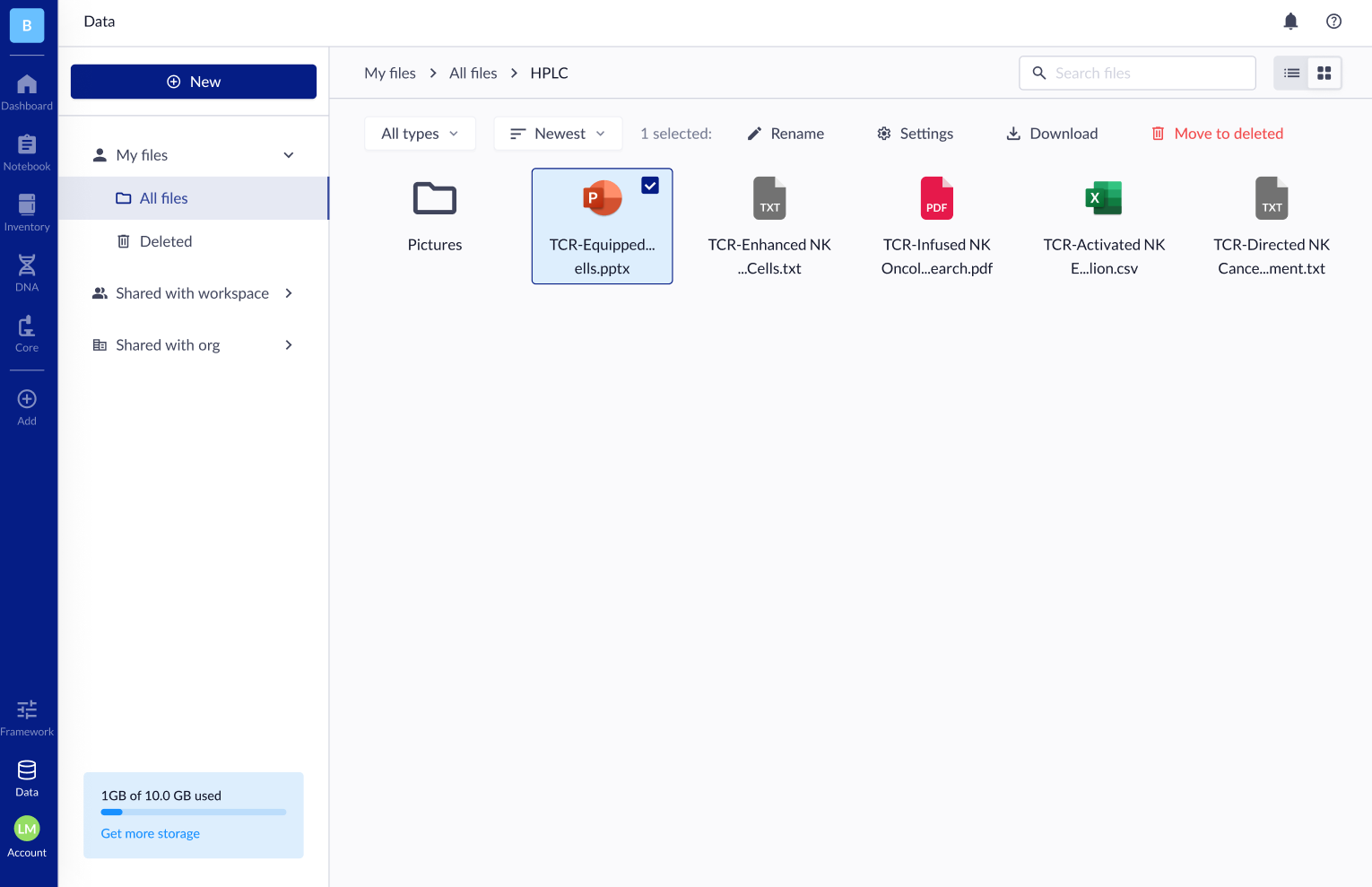
Biopharma R&D depends on collaboration across research, process development, analytics, quality, and external partners. Yet as teams grow, collaboration often leads to file duplication rather than alignment. Documents are copied, renamed, and shared across tools, creating parallel versions that quickly drift out of sync.
A centralized file repository enables collaboration without creating unnecessary copies. Instead of distributing files via email or duplicating folders for each team, collaborators can access the same authoritative files within a shared system. This approach reduces confusion and ensures everyone is working from the same information.
Centralized file repositories improve collaboration by:
Providing shared access to files across teams and roles
Reducing reliance on email attachments and ad hoc file transfers
Maintaining a single, up-to-date version of each file
Allowing controlled access for internal teams and external collaborators
When files are centrally managed, collaboration becomes more transparent. Teams can see updates as they happen, understand who made changes, and trust that the information they are using is current. This is especially important when multiple groups depend on the same data to make decisions at different stages of development.
By removing duplication from the collaboration process, biopharma organizations can reduce errors, improve alignment, and move more efficiently from research through development—without adding administrative overhead.
Connecting Files to Experiments, Samples, and Scientific Context
In many R&D environments, files exist in isolation—stored in folders without clear links to the experiments, samples, or processes they support. This lack of context makes it difficult to understand how data was generated, how it should be interpreted, or how it connects to downstream work. Over time, even well-documented files lose value when their scientific context is unclear.
A centralized file repository becomes far more powerful when files are connected directly to the lab’s core entities. By linking files to specific experiments, samples, projects, or workflows, teams can quickly understand the full story behind the data. This contextualization reduces misinterpretation and eliminates the need to manually piece together information from multiple systems.
Connecting files to scientific context enables teams to:
Trace data back to its source, including the experiment or sample that generated it
Preserve experimental intent and conditions alongside raw data and results
Improve knowledge transfer across teams and over time
Support reproducibility by maintaining clear relationships between files and lab activities
This approach is especially valuable as teams scale and turnover increases. New scientists can ramp up faster when files are not just stored, but meaningfully connected to the work they represent. Instead of relying on institutional knowledge or informal explanations, the repository itself provides clarity.
By embedding files within their scientific context, biopharma organizations transform static documents into usable, trustworthy knowledge—reducing errors, supporting continuity, and strengthening long-term R&D operations.
Genemod’s Centralized File Repository as the Foundation for Future-Ready Labs

As biopharma R&D organizations prepare for continued growth, increasing data volume, and higher regulatory expectations, file management can no longer be an afterthought. Future-ready labs require infrastructure that not only stores files, but actively supports how science is done today—and how it will scale tomorrow.
Genemod’s centralized file repository is designed with this reality in mind. Rather than operating as a standalone storage layer, it integrates directly into the broader lab environment, allowing files to live alongside experiments, samples, inventory, and workflows. This ensures files retain their scientific context while remaining easy to access, search, and manage.
By centralizing files within Genemod, teams can:
Establish a trusted system of record for scientific and operational data
Reduce rework and data loss through structured access and version control
Enable collaboration at scale without duplicating or fragmenting files
Prepare for audits and future compliance needs with clearer traceability
Most importantly, a centralized file repository creates a foundation for what comes next. As labs adopt more automation, analytics, and AI-driven workflows, structured and contextualized data becomes essential. Files that are organized, connected, and governed today are what enable smarter discovery, faster decision-making, and sustainable scale tomorrow.
For biopharma teams looking to move beyond file sprawl and build resilient R&D operations, centralized file management isn’t just an efficiency upgrade—it’s a strategic investment in the future of their lab.


