


1. From Traditional ELNs to Modern ELNs — What to Seek in 2026
For years, ELNs acted as digital notebooks — a place to type notes, upload files, and replace paper. They stored information, but did not help scientists organize it, reuse it, or work faster. In 2026, this is no longer enough. Labs need ELNs that support how research actually happens: quick to use, flexible, and designed around data rather than static text.
A modern ELN should feel lightweight and intuitive so that scientists can document without friction. It must treat data as structured knowledge, not just attachments — allowing easy import from existing sources, clean export at any time, and metadata that makes entries discoverable later. AI is also expected as a native capability: helping draft experiment outlines, summarize notes, and surface relevant past work. Instead of being passive storage, a 2026 ELN should actively reduce effort, make information easier to retrieve, and grow with the team.
2. Limitations of Legacy ELN Systems
Legacy ELNs were designed to digitize notebooks, not to accelerate scientific work. They treat experiments as static pages—heavy on text, weak on structure—so researchers end up rewriting information, duplicating tables, and manually recreating templates. Because they don’t prioritize searchable or reusable data, past work becomes difficult to navigate, and valuable context is buried instead of surfaced.
These systems also introduce usability friction: complicated interfaces, rigid workflows, and keyword-only search that forces users to remember exact terms from older entries. Onboarding becomes slow, adoption remains low, and documentation quality declines over time. The final pain point is vendor lock-in. Importing and exporting data often breaks formatting or loses structure, making it hard to migrate or share information. As a result, teams get stuck storing information in a tool that doesn’t help them use it.
3. Core Functional Requirements in 2026 ELN Software
A modern ELN is not defined by how many features it has, but by how effectively it reduces friction in everyday scientific work. Researchers should be able to document naturally, retrieve information instantly, and own their data without barriers. The tools below are not “nice to have”—they are the baseline expectations for an ELN built for 2026.
3.1. Lightweight and intuitive UX (scientists should not need training)
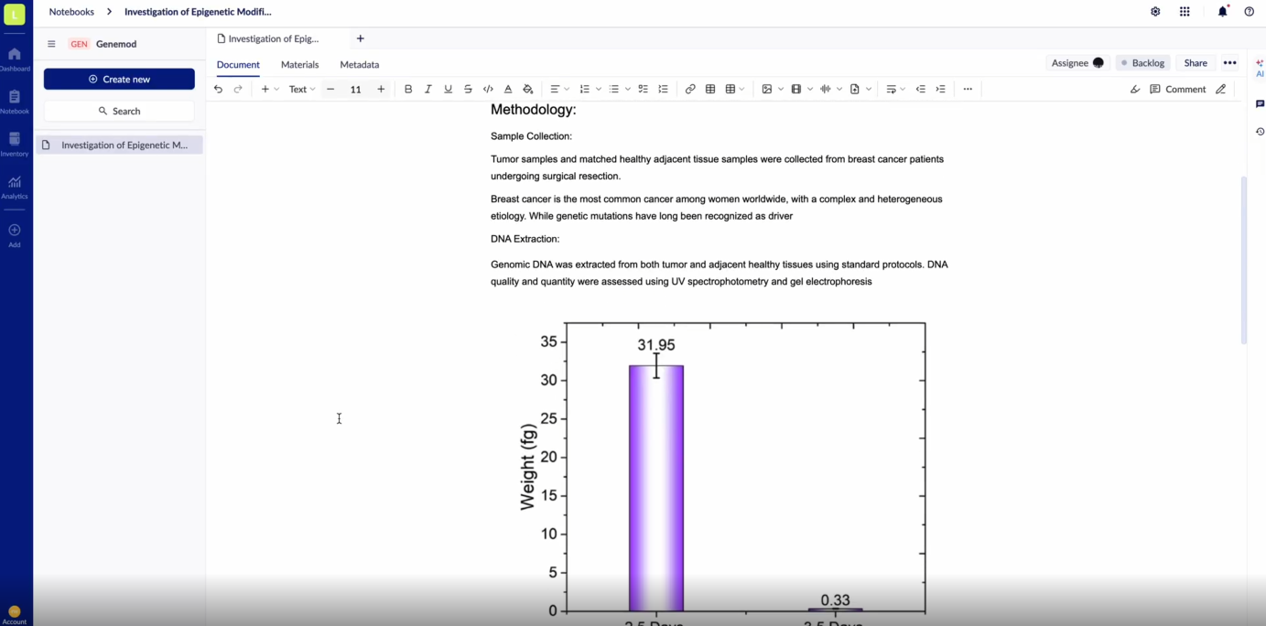
A 2026 ELN must feel simple from the moment a user opens it. Scientists should be able to create a new experiment, add tables, paste results, and attach files without navigating menus or reading tutorials. The UI should work like a familiar writing tool—not enterprise software—with actions that are obvious and reversible. When researchers must learn new workflows, attend training, or adapt to rigid structures, adoption plummets. The ELN should adapt to scientists’ habits, not force scientists to adapt to the software.
3.2. Data-friendly architecture (beyond static notes)
Legacy ELNs treat entries like digital pages. A modern ELN treats experiments as structured data: titles, steps, conditions, tables, attachments, and contextual metadata. Users must be able to add numeric fields, dropdown lists, tags, comments, or experiment links without breaking their workflow. Every entry should be fully searchable—not only by literal keywords, but by attributes and context. This enables experiment comparison, pattern recognition, and continuity when projects evolve over months or years. A data-friendly ELN turns past documentation into reusable knowledge.
3.3. Easy and reliable import (no rebuilding from scratch)
Teams should never have to manually recreate their history. The ELN must provide guided import from CSV or Excel and preserve structure when bringing in older data. Tables should remain intact, attachments stay linked, and formatting should not collapse. Importing should not require engineering help or specialized plugins—scientists should be able to do it themselves. This matters most when onboarding new teams or consolidating fragmented documentation. If importing becomes a technical project, people default to spreadsheets again, and the ELN loses its value.
3.4. Complete, portable export
Exporting should be effortless and transparent. Labs must be able to export individual experiments, entire projects, or even full databases without losing tables, timestamps, attachments, or revision history. Modern ELNs should not flatten everything into PDFs or partial backups that break relationships between entries. Scientists need to share work externally, archive it, or migrate systems when necessary. Any ELN that restricts exports—or charges extra for them—undermines long-term usability. In 2026, data ownership is fundamental, not optional.
3.5. Practical collaboration features
Documentation is rarely an individual activity. Scientists need real-time co-editing, inline comments, tagging, and clear change history so multiple contributors can work without confusion. Reviews and conversations must exist beside the experimental record—not scattered across emails or chat apps. The ELN should allow researchers to annotate tables, highlight steps, and discuss observations inside the document itself. Effective collaboration prevents duplicated effort, accelerates decisions, and preserves context for anyone revisiting the work later.
3.6. AI-assisted experiment drafting
Researchers should be able to begin with a structured outline instead of a blank page. AI can propose titles, step sequences, tables, and sections based on the user’s intent. This reduces the time spent formatting and allows researchers to focus on content rather than structure. When repeated workflows are involved, AI can convert them into reusable templates, so the lab’s knowledge compounds instead of being rewritten each time.
3.7. AI-driven summaries
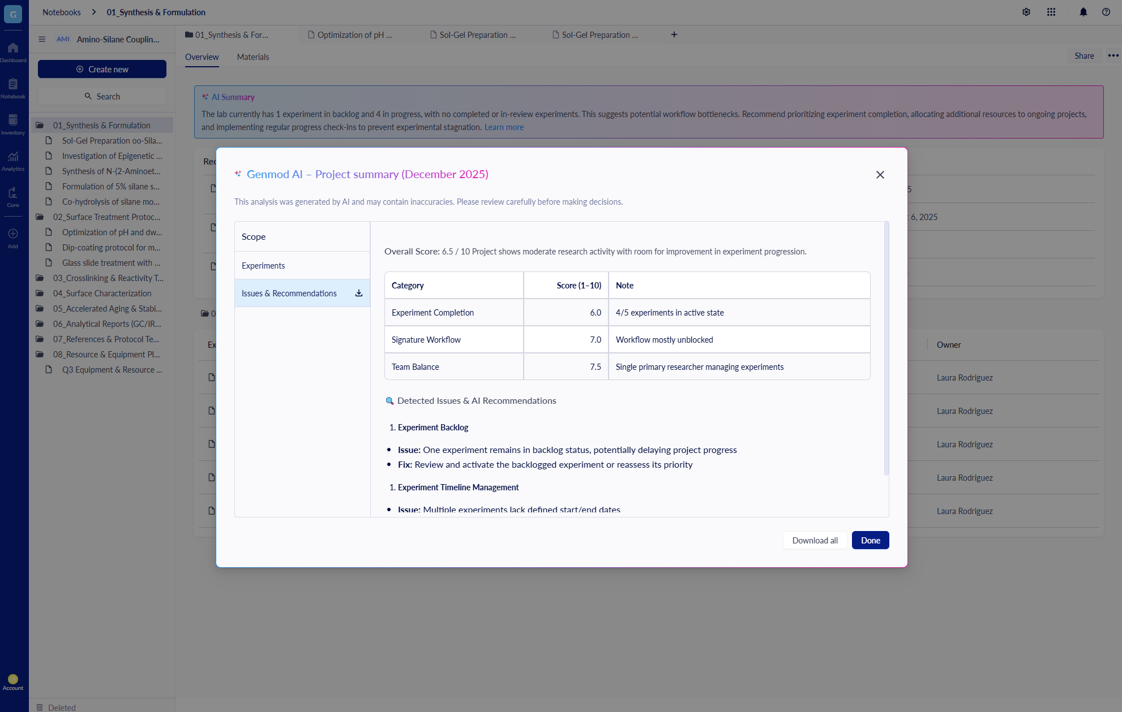
Long experiments often become difficult to revisit, especially when accumulated over weeks or months. An AI-native ELN should take a detailed entry and produce a concise, readable summary, highlighting key steps, conditions, and outcomes. This helps scientists prepare for internal reviews, project updates, and handoffs without rereading entire notebooks. Summaries should be customizable—short versions for meetings, detailed versions for reports.
4. How to Evaluate the Right ELN Software for Your Lab
Choosing an ELN is not about who has the longest feature list—it is about how well the system fits the way scientists actually work. Instead of basing decisions on polished demos, start by testing usability yourself: open a blank page, add notes, build a table, attach files, and edit formatting. If those basic actions require excessive clicks, training, or constant menu-hunting, adoption will drop immediately. Next, evaluate import and export realistically using your own files, not vendor samples. A reliable ELN should preserve tables, attachments, and structure without forcing you to reformat data or rebuild history, and it should allow full project export at any time without losing metadata or revision logs. Look closely at how the ELN handles information—whether it treats experiments as living, structured records with fields and searchable attributes, or simply as rich-text documents. Search and organization should reflect structure, enabling you to filter, group, and connect entries without digging through pages.
AI capabilities should also be examined in context. Real value comes from AI that understands experiments, assists with drafting or summarizing, and improves retrieval—not a generic chatbot that adds noise. Finally, consider long-term independence. The right ELN should respect data ownership, avoid hidden lock-ins, and grow with your team instead of pushing rigid workflows or contract-based traps. A platform that remains usable even if you choose to leave it is the one that will serve your lab best.
5. Genemod Case Study — Antharis Therapeutics
Antharis Therapeutics is a growing biopharmaceutical company developing novel biologics, including viral vectors for gene therapy. With upstream, downstream, and analytical teams working in parallel, their process development group needed a single platform to manage documentation, inventory, and collaboration more efficiently. Genemod provided that foundation by centralizing experiment records and lab inventory in one place.
With Genemod, Antharis standardized experiment documentation and eliminated manual tracking. Real-time inventory visibility helped the team prevent stockouts, reduce duplicate purchases, and anticipate material needs. Project folders enabled cross-functional collaboration—allowing upstream, downstream, and analytical groups to share experiments seamlessly and review work without digging through scattered files. As Lab Coordinator Mason K. noted, “Genemod has streamlined our procurement process and our file sharing process, saving us time and helping us focus on the science.”
The platform’s intuitive interface allowed researchers to adopt it quickly, replacing siloed tools and inconsistent workflows with a unified system. As Antharis expanded, Genemod continued to evolve alongside the team—introducing features shaped by their real-world laboratory feedback. For more information, check out the full case study.
6. Conclusion — Why Genemod Is the #1 ELN in 2026
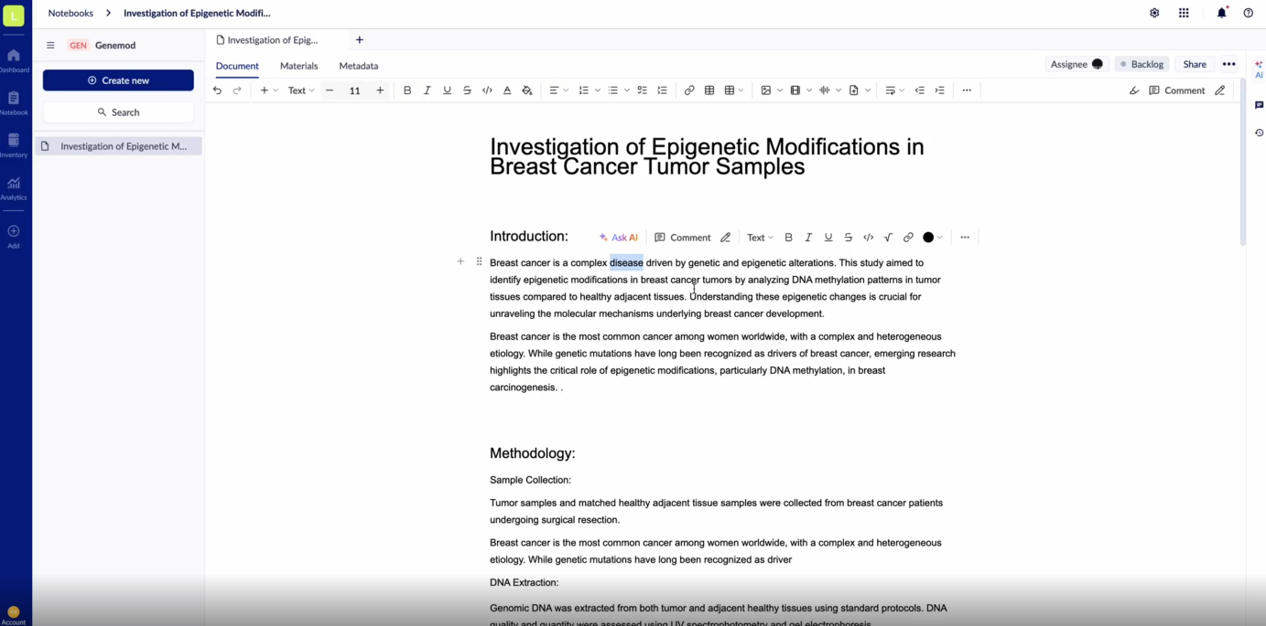
Modern laboratories expect more from an ELN than static documentation. They need simplicity, flexibility, and intelligent support that helps them work faster—not software that adds complexity or traps their data. Genemod is built around these principles. It offers a lightweight, intuitive experience that scientists can adopt immediately, without training or workflow disruption. Its data-friendly architecture treats experiments as structured knowledge, enabling clean organization, fast retrieval, and seamless reuse. Import and export are transparent and reliable, giving teams full ownership of their information and eliminating the fear of vendor lock-in.
Genemod also integrates AI where it creates real value. Instead of bolted-on chat interfaces, AI is applied to drafting, summarizing, structuring, and searching scientific records—reducing repetitive work and helping researchers focus on insight rather than formatting. Collaboration features further support day-to-day lab work, allowing teams to share experiments, comment in context, and maintain continuity as projects evolve.
The result is an ELN that scientists actually use. Genemod doesn’t force labs into rigid systems or oversized enterprise platforms—it supports real documentation habits and scales organically as teams grow. In 2026, choosing the right ELN is about usability, portability, and intelligent assistance. Genemod delivers all three, making it the most practical and future-ready ELN for modern research environments.


